

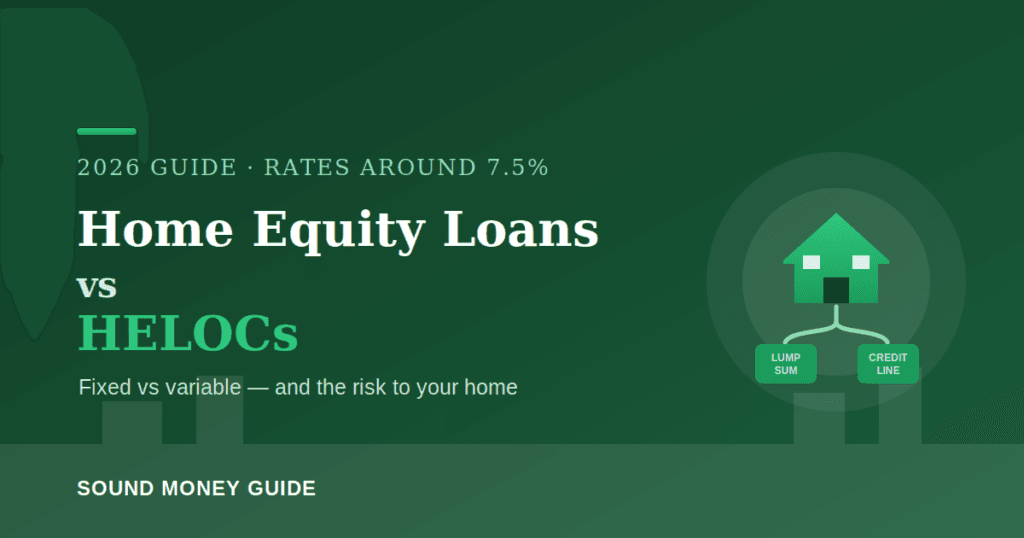
If you own a home, you’re likely sitting on significant equity — and two products let you borrow against it: a home equity loan (a lump sum at a fixed rate) and a HELOC (a revolving credit line at a variable rate). Both are among the cheapest borrowing available, with 2026 rates averaging around 7.5%, far below credit cards. But both share one serious risk that deserves your full attention: your home is the collateral. This guide explains how each works, runs the real numbers, and helps you choose — or decide neither is right for you.
Rates below are current as of August 2026 and vary by lender, credit profile, and loan-to-value. Always confirm current terms with lenders before borrowing.
Disclosure: This article is for general information only and is not financial advice. Borrowing against your home is a major decision — consider speaking with a financial advisor.
First: how much can you borrow?
Both products let you tap the equity you’ve built. Most lenders allow you to borrow up to 80% to 85% of your home’s value, minus what you still owe on your mortgage. (This is your combined loan-to-value, or CLTV.)
Example: Your home is worth $400,000 and you owe $220,000 on your mortgage.
- Your total equity: $180,000
- At 80% CLTV: $400,000 × 80% = $320,000 − $220,000 mortgage = borrow up to $100,000
- At 85% CLTV: $400,000 × 85% = $340,000 − $220,000 mortgage = borrow up to $120,000
Note you generally can’t borrow your full equity — lenders keep a cushion. Your actual limit also depends on your credit score, income, and debt-to-income ratio.
What is a home equity loan?
A home equity loan is often called a second mortgage. You receive a single lump sum and repay it in fixed monthly payments over a set term — commonly 5 to 15 years (some lenders go to 30).
- Fixed interest rate — locked at closing; your payment never changes
- Lump sum upfront — you get all the money at once
- Predictable — you know the exact payment and payoff date from day one
- You pay interest on the full amount from day one, whether you use it all immediately or not
Best for: a known, one-time expense — a major renovation with a firm quote, or a specific debt to clear.
What is a HELOC?
A HELOC (home equity line of credit) works more like a credit card secured by your home. You’re approved for a credit limit and draw from it as needed.
It has two distinct phases:
- Draw period (commonly up to 10 years) — borrow what you need, when you need it. Payments are often interest-only, and you only pay interest on what you’ve actually drawn. You can repay and re-borrow.
- Repayment period (commonly 10–20 years after) — the draw window closes. You can no longer borrow, and you must repay principal and interest. Your payment increases, often sharply.
- Variable interest rate — usually the prime rate plus a margin, so it moves with Federal Reserve policy
- Flexible — only borrow (and pay interest on) what you use
- Some lenders offer a fixed-rate option to lock in portions of your balance
Best for: ongoing or uncertain costs — a phased renovation, or a standby safety net.
Where rates stand in 2026
As of mid-2026, the averages are close together: roughly 7.50% for HELOCs and 7.57% for home equity loans (Curinos data). Depending on your credit score and CLTV, offers commonly range from about 7% to 11.5%.
Two things matter more than that small average gap:
- HELOC rates are variable. A HELOC may start slightly lower, but it can rise. Some also carry introductory “teaser” rates that expire after six to twelve months, after which the rate adjusts upward. This is the same variable-rate mechanism behind an adjustable-rate mortgage.
- Home equity loan rates are fixed. You pay a little more for certainty, and in a volatile rate environment that certainty has real value.
Side-by-side comparison
| Home Equity Loan | HELOC | |
|---|---|---|
| Structure | Lump sum | Revolving credit line |
| Interest rate | Fixed (~7.57% avg) | Variable (~7.50% avg) |
| Payment | Fixed, predictable | Varies; often interest-only during draw |
| Interest charged on | Full amount from day one | Only what you’ve drawn |
| Term | Typically 5–15 years | ~10-year draw, then repayment period |
| Re-borrow? | No | Yes, during the draw period |
| Best for | Known one-time expense | Ongoing or uncertain costs |
| Main risk | Borrowing more than you need | Rate rises + payment shock |
| Collateral | Your home | Your home |
The math: what these actually cost
A $50,000 home equity loan at 7.75% fixed:
| Term | Monthly payment | Total interest |
|---|---|---|
| 10 years | $600.05 | $22,006 |
| 15 years | $470.64 | $34,715 |
| 20 years | $410.47 | $48,514 |
Same lesson as any loan: a longer term lowers the payment but costs far more. Stretching from 10 to 20 years saves $190 a month — and costs $26,508 extra in interest.
A $50,000 HELOC at 7.50% — this is where people get caught out:
- During the draw period (interest-only): about $312.50/month
- When repayment begins (assuming you still owe $50,000):
- Over 15 years: $463.51/month — a 1.5× jump
- Over 10 years: $593.51/month — a 1.9× jump, nearly $281 more per month
That’s the payment shock at the end of the draw period, and it’s the single most common HELOC surprise. If you only make interest-only payments, you haven’t reduced the balance at all — you simply owe the same amount with far less time to repay it.
And the variable-rate risk, on that same $50,000 interest-only balance:
- At 7.5%: $312.50/month
- At 9.5%: $395.83/month
- At 11.5%: $479.17/month
Your payment can rise substantially without you borrowing another cent.
(All figures illustrative; your rate, term, and balance will differ.)
The serious risk: your home is the collateral
This matters more than any rate comparison, so let’s be direct.
Both products are secured by your home. If you can’t make the payments, the lender can foreclose. That’s the fundamental trade-off: you get a much lower rate than unsecured borrowing because the lender has your house as security.
This is especially important when people consider using home equity to consolidate credit card debt. The math looks compelling — $30,000 of card debt at 22% costs about $6,600 in interest in the first year alone, while a 10-year home equity loan at 7.75% would run about $360/month with roughly $13,204 in total interest over the decade.
But look carefully at what you’re doing: you’re converting unsecured debt into debt secured by your home. Credit card companies can damage your credit and pursue you; they cannot take your house. After this move, they effectively can. You may also stretch a few years of debt across ten, paying more overall despite the lower rate.
That doesn’t make it wrong — for a disciplined borrower with stable income, it can save real money. But it deserves careful thought, ideally with a financial advisor, and never as an impulse decision. If the spending habit that created the card debt hasn’t changed, you risk ending up with both a home equity loan and new card balances. (Our guide to debt consolidation loans covers the unsecured alternative.)
Which should you choose?
Choose a home equity loan if:
- You know exactly how much you need (a firm renovation quote, a specific debt)
- You want a fixed rate and a predictable payment
- You’d rather not risk rate increases
- You want a clear payoff date
Choose a HELOC if:
- Your costs are spread over time or uncertain (a phased project)
- You want to borrow only what you use and pay interest only on that
- You can absorb a rate increase and plan for the repayment-period jump
- You want a standby line you may not fully draw
Consider neither if:
- Your income is unstable — missing payments risks your home
- You’d be borrowing for discretionary spending rather than genuine need
- You could cover the expense from savings or an unsecured loan at a reasonable rate
- You’ve little equity, meaning fees and closing costs eat much of the benefit
Practical tips
- Shop several lenders — banks, credit unions, and online lenders price second mortgages differently. Compare APR (which includes fees), not just the rate.
- Ask about closing costs — home equity products can carry appraisal, origination, and title fees. Some lenders waive them; some claw them back if you close the line early.
- On a HELOC, ask about the fixed-rate option — many lenders let you lock portions of your balance.
- Plan for the repayment period now. Before opening a HELOC, calculate what the payment becomes when the draw period ends. If that number worries you, a fixed home equity loan may suit you better.
- Pay more than interest-only during a HELOC draw period if you can — it’s the only way to avoid the full payment shock later.
- Consider whether a cash-out refinance fits better if you’d also benefit from changing your first mortgage. (See our guide to mortgage refinancing.) If your existing mortgage rate is low, keeping it and adding a second lien usually costs less than refinancing everything.
Frequently asked questions
How much equity do I need? Most lenders want you to retain 15–20% equity after borrowing, so you generally need meaningful equity built up. Your borrowing limit is roughly 80–85% of your home’s value minus your mortgage balance.
Which has lower rates in 2026? They’re very close — around 7.50% for HELOCs and 7.57% for home equity loans on average. But HELOC rates are variable and can rise, while home equity loan rates are fixed.
Is the interest tax-deductible? It may be if the funds are used to buy, build, or substantially improve the home securing the loan, subject to limits. Rules are specific — consult a tax professional about your situation.
What happens when my HELOC draw period ends? You can no longer borrow, and you begin repaying principal plus interest. Payments typically increase substantially — potentially 1.5× to 2× your interest-only payment.
Can I lose my home? Yes. Both products use your home as collateral, so defaulting can lead to foreclosure. This is the single most important consideration.
Should I use home equity to pay off credit cards? Sometimes it makes financial sense given the rate difference — but it converts unsecured debt into debt secured by your home. Weigh it carefully, and address the underlying spending first.
The bottom line
Home equity loans and HELOCs both offer some of the cheapest borrowing available — around 7.5% in 2026, versus 22%+ on credit cards. Choose a home equity loan when you know the amount and want a fixed, predictable payment; choose a HELOC when your costs are spread over time and you can handle a variable rate plus the payment jump when the draw period ends. But never lose sight of the trade-off that makes those low rates possible: your home secures the debt. Borrow only what you genuinely need, for something worth that risk, and make sure you can afford the payment in every scenario — not just today’s.
Related reading: Compare unsecured options in our guide to debt consolidation loans and best personal loans in North Carolina, and see whether changing your first mortgage makes sense in mortgage refinancing.
Sources
- Bankrate — HELOC vs. Home Equity Loan: https://www.bankrate.com/home-equity/home-equity-loan-vs-line-of-credit/
- Experian / Curinos — Home Equity Rates: HELOC vs. Home Equity Loan (July 2026): https://www.experian.com/blogs/ask-experian/home-equity-rates-heloc-vs-home-equity-loan/
- Consumer Financial Protection Bureau (CFPB) — Home equity products: https://www.consumerfinance.gov/
- Federal Reserve H.15 — Prime rate: https://www.federalreserve.gov/releases/h15/
General information, not personalized financial advice. Rates and terms were current as of August 2026, vary by lender and borrower, and change frequently — verify all terms before borrowing. Borrowing against your home carries the risk of foreclosure; consider consulting a financial advisor.
