

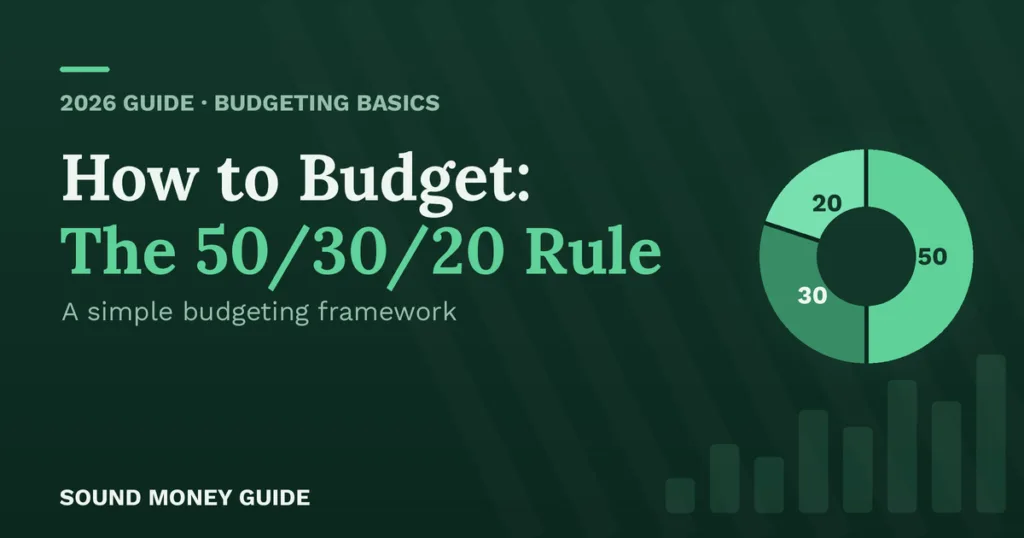
“Budgeting” sounds like something you need a spreadsheet, a finance degree, or an evening you don’t have to do properly. It doesn’t have to be. The 50/30/20 rule is a way to sort your income into three buckets — needs, wants, and savings — without tracking every coffee you buy. It won’t fit everyone’s situation perfectly, and it isn’t meant to. This guide explains how the rule works, where it comes from, when to bend it, and why the savings slice matters more than it looks.
This is general educational information, not personalized financial advice. Figures are illustrative and current as of 2026.
Where the 50/30/20 rule comes from
The 50/30/20 split isn’t a government requirement or a law — it’s a rule of thumb, popularized in personal finance writing and since adopted into financial education materials, including some published by the Consumer Financial Protection Bureau (CFPB). The CFPB’s own toolkits use the 50/30/20 framework to teach budgeting basics, while being explicit that it’s a starting point, not a formula everyone must follow exactly. The rule is meant to be adjusted, not obeyed. If your rent alone eats 45% of your paycheck, that’s useful information about your situation — not proof you’re budgeting wrong.
The three buckets, explained
Needs — 50% of your take-home pay. This is everything you can’t reasonably skip: rent or mortgage, utilities, groceries, insurance, minimum debt payments, transportation to get to work. If cutting it would mean missing a bill or going without something essential, it’s a need.
Wants — 30% of your take-home pay. This is spending that improves your life but isn’t required: restaurants, streaming subscriptions, hobbies, upgrading a phone before the old one breaks. The test isn’t whether you enjoy it — it’s whether you’d genuinely be fine without it for a month.
Savings and extra debt payments — 20% of your take-home pay. This bucket covers building an emergency fund, retirement contributions, and paying more than the minimum on debt you’re trying to clear faster. It’s the bucket that gets skipped first when money is tight, which is exactly why it’s worth protecting on purpose.
All three percentages apply to net income — what actually lands in your account after taxes, not your gross salary.
When to adjust the percentages
The 50/30/20 split assumes a household where needs genuinely take up half of income. That’s not everyone’s reality. A few common adjustments:
High cost-of-living areas. If rent alone runs 40-50% of your income, the 50% needs bucket may simply not have room for anything else. In that case, the honest move is to shrink the wants bucket, not pretend the numbers work.
High-interest debt. If you’re carrying credit card debt at 20%+ APR, putting more than 20% toward paying it down can save you more than a strict 30% wants allocation would cost you in enjoyment. The math on carrying high-interest debt rarely favors sticking to a fixed percentage.
Irregular income. Freelancers and gig workers often find fixed percentages awkward month to month — building a buffer first, then applying the percentages to an averaged income, tends to work better than recalculating the split every time a paycheck varies.
Why the 20% matters more than it looks
This is the bucket most people cut first, and the data suggests that’s a costly habit. A 2022 CFPB report on emergency savings found that 24% of consumers had no emergency savings at all, and 39% had saved less than one month’s income. Put together, that’s a large share of households with little or no cushion against an unexpected expense.
The CFPB’s own consumer education materials, including its “Your Money, Your Goals” toolkit, suggest starting with $500 as an initial emergency-savings goal — not the full three-to-six-months-of-expenses target most guides eventually recommend, but a starter cushion that covers a lot of common emergencies: a car repair, a medical copay, a plane ticket for a family emergency.
That’s the practical case for the 20% bucket: it’s not about optimizing returns, it’s about making sure the next surprise expense doesn’t have to go on a credit card. Once you clear a small cushion, that same 20% can shift toward paying down expensive debt faster, then toward a fuller emergency fund and retirement contributions. Setting up automatic transfers on payday is the easiest way to make that 20% happen without relying on willpower each month. See how to automate your savings for the simplest ways to do it.
A worked example
Take someone earning $4,000 a month after tax:
- Needs (50%) = $2,000 — rent, utilities, groceries, insurance, minimum debt payments.
- Wants (30%) = $1,200 — dining out, subscriptions, hobbies, discretionary purchases.
- Savings & extra debt payments (20%) = $800 — building the emergency fund, then extra payments on any high-interest balance.
If the needs bucket runs over — say, rent alone is $2,400 — the adjustment comes from the wants side, not from skipping savings altogether. Protecting even a smaller slice for savings, rather than zeroing it out, is what keeps a bad month from turning into new debt.
Frequently asked questions
Does the 50/30/20 rule apply to gross or net income? Net income — what actually hits your bank account after taxes and other paycheck deductions. Using gross income overstates how much you actually have to work with.
What if my needs are more than 50% of my income? Then the rule is telling you something useful: either your needs are genuinely higher than typical (common in expensive housing markets), or there’s room to renegotiate a bill or reduce a fixed cost. The fix is to shrink the wants percentage, not to abandon saving.
Is the CFPB’s 50/30/20 guidance an official rule I have to follow? No. It’s presented as a starting framework in educational materials, explicitly meant to be adjusted to fit your situation — not a regulation or a one-size-fits-all formula.
Should I use 50/30/20 if I have high-interest debt? Consider shifting more than 20% toward debt if the interest rate is high — the math on carrying a 20%+ APR balance rarely favors keeping a full 30% wants bucket instead. See debt avalanche vs snowball for how to prioritize which debt to attack first.
Does budgeting with 50/30/20 affect my credit score? No — the rule affects your cash flow, not your credit file. What affects your score is paying on time and keeping credit utilization low, regardless of how you structure your budget.
What’s a realistic first savings goal if I’m starting from zero? A commonly cited starting point is around $500 — enough to cover many common emergencies without derailing your other buckets. From there, the goal typically grows toward a few months of expenses. See emergency fund: how much and where to keep it for the fuller picture. A high-yield savings account is the standard place to keep that money while it grows.“
The bottom line
The 50/30/20 rule isn’t a law, and it isn’t meant to fit every budget perfectly — it’s a starting point for sorting income into needs, wants, and savings, with room to adjust based on your actual cost of living and debt. The percentage that matters most is the 20%: a 2022 CFPB report found that a large share of households have little or no emergency savings, and even a small starter cushion — the CFPB’s own materials suggest around $500 — can be the difference between an unexpected expense and new debt. Run your own numbers, adjust where your situation demands it, and treat the 20% as the one bucket worth protecting first.
Related reading: Once you have a budget structure, build the safety net behind it in emergency fund: how much and where to keep it, and if you’re carrying debt alongside your budget, compare payoff strategies in debt avalanche vs snowball.
Sources
Consumer Financial Protection Bureau (CFPB) — Learning About Budgets: https://www.consumerfinance.gov/consumer-tools/educator-tools/youth-financial-education/teach/activities/learning-about-budgets/
CFPB worksheet, “My Spending Rule to Live By”: https://files.consumerfinance.gov/f/documents/cfpb_worksheet_my-spending-rule-to-live-by.pdf
Emergency Savings and Financial Security report, CFPB (2022): https://files.consumerfinance.gov/f/documents/cfpb_mem_emergency-savings-financial-security_report_2022-3.pdf
